
Gas Detection Systems For Workplace Safety
EMCO offers a comprehensive range of Gas Detection Systems. To protect employees we offer wall mounted instruments with remote sensors, or personal wearable monitors. Our systems are customisable to suit virtually all applications and gases.
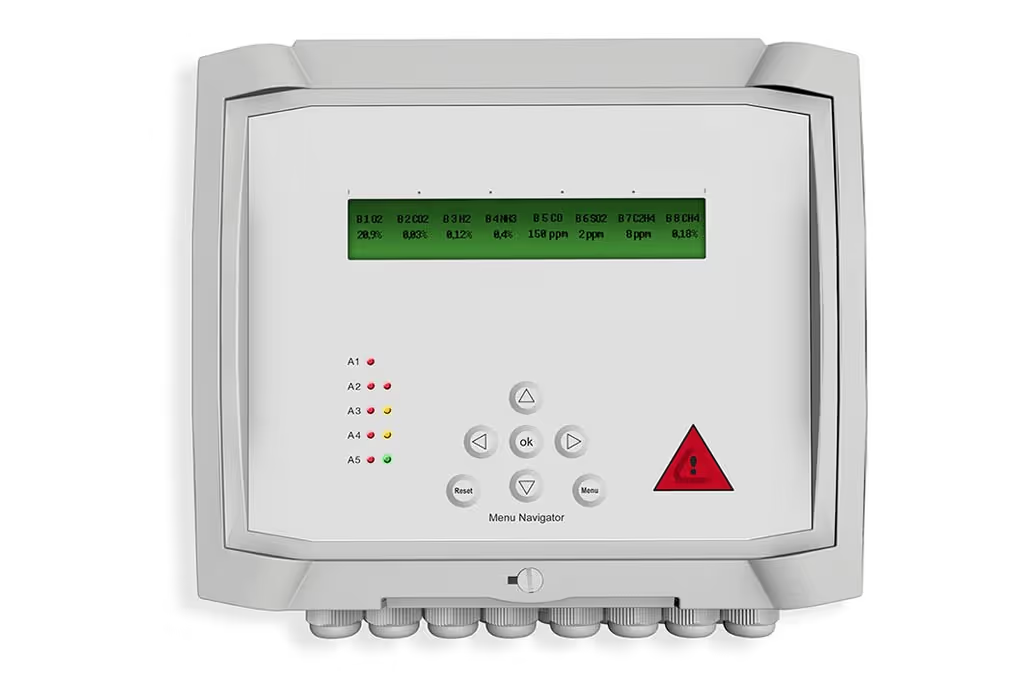
Fixed And Wearable Monitors For CO2, Oxygen Depletion And Toxic Gases
Which gas hazard actually kills people in food and manufacturing plants? Almost always the one nobody can smell. Carbon dioxide and nitrogen are colourless and odourless, heavier or lighter than air depending on the gas, and they displace oxygen in enclosed spaces long before anyone notices feeling unwell. By the time symptoms register, judgement is already impaired.
EMCO supplies fixed wall-mounted systems with remote sensor heads and personal wearable monitors, configurable to virtually any gas and application, so exposure is detected and alarmed before it becomes an incident.
Gas Detection Systems For Workplace Safety
What Do Gas Detection Systems Protect Against?
Gas detection protects people working around stored, piped and generated gases. In food production that typically means carbon dioxide around beverage and packing lines, cellars and ripening rooms, nitrogen around cryogenic storage and freezing tunnels, ammonia around refrigeration plant, and oxygen depletion in any confined space where an inert gas can accumulate. The same risks appear in laboratories, pharmaceutical manufacturing, welding bays and hospital plant rooms. None of these gases announce themselves — the ones that cause the most harm are colourless and odourless, which is exactly why measurement rather than judgement is the only reliable control.
Fixed Versus Personal Monitoring
Fixed systems use a wall-mounted controller with remote sensor heads placed where the gas will actually collect, which depends on whether it is heavier or lighter than air. Alarms are configurable to site thresholds and can drive sounders, beacons, ventilation and interlocks, so a rising concentration triggers a response before anyone has to notice and react. Personal wearable monitors go with the individual instead, which suits maintenance teams, contractors and anyone entering a confined space where a fixed installation would not help. Most sites end up running both: fixed coverage for known risk areas, personal monitors for anyone whose work takes them somewhere the fixed system does not reach.
Why Placement And Calibration Decide Whether A System Works
The most common fault is not equipment failure but incorrect sensor placement, since carbon dioxide collects low and lighter gases collect high, and a sensor mounted to a standard layout rather than the actual site geometry will miss the risk it was installed to catch. Calibration on a defined schedule matters just as much: an uncalibrated detector reads reassuringly and tells you nothing, which is more dangerous than having no detector at all. EMCO specifies systems around the actual site rather than selling a fixed configuration, and offers calibration and servicing through its own programme.
Key Points
- Fixed wall-mounted systems with remote sensor heads
- Personal wearable monitors for individuals and confined space entry
- Carbon dioxide, oxygen depletion, ammonia, nitrogen and toxic gas detection
- Configurable alarm thresholds with sounder, beacon and interlock outputs
- Sensor placement specified to gas density and site layout
- Customisable to virtually all applications and gases
- Integration with existing plant and building systems
- Calibration, servicing and certification available
- Backed by the EMCO service level guarantee
FAQs About Gas Detection Systems And Workplace Gas Safety
Which gases most often need monitoring in food production?
Carbon dioxide is the most common, around beverage lines, cellars, ripening rooms and packing halls. Nitrogen and oxygen depletion matter around cryogenic storage and freezing, and ammonia around refrigeration plant.
Do we need fixed detectors or personal monitors?
Usually both. Fixed detectors protect a space continuously and can trigger ventilation or interlocks. Personal monitors protect the individual wherever they go, which is what confined space entry and maintenance work require.
Where should sensors be positioned?
It depends on the gas. Carbon dioxide is heavier than air and collects low, so sensors sit near floor level. Lighter gases need high mounting. Getting this wrong is the most common fault we see, which is why we specify placement around the actual site rather than to a standard layout.
How often do gas detectors need calibrating?
Sensors drift and eventually expire, so calibration on a defined schedule is essential. An uncalibrated detector reads reassuringly and tells you nothing, which is more dangerous than having no detector at all.
Can a system alarm and take action automatically?
Yes. Alarm outputs can drive sounders and beacons, start extraction or ventilation, and interlock with plant, so the response begins before anyone has to make a decision.
Can detection be set up for an unusual gas?
Yes. Our systems are customisable to suit virtually all applications and gases, and we build custom configurations where a standard product does not cover the requirement.


