
Near Infrared Technology: How NIR Improves Food Production

In food production, accurate measurement of parameters such as moisture, colour, and fat is essential for maintaining product quality, shelf life, and consistency.
Traditional testing methods, such as chemical analysis, often involve taking samples from the line and analysing them later, which can delay decisions and make it harder to monitor the production process.
Near Infrared (NIR) technology allows manufacturers to measure these parameters instantly, directly on the production line, without disrupting the process.
By providing real-time data, NIR helps food producers improve efficiency, consistency, and process control while reducing waste and costs.
Why Measurement Is Critical in Food Production
Food quality depends on controlling key parameters such as moisture, fat and oil, protein, and colour or degree of bake. Even small variations in these values can affect how a product looks, tastes, and performs throughout its shelf life.
Without reliable measurement, these parameters can fall outside of specification during production.
This can lead to:
- inconsistent product quality between batches
- spoilage or mould growth due to excess moisture
- texture problems, such as stale, soft, or overly dry products
- increased product waste from off-spec batches.
Traditional Testing Methods in Food Production
Before near-infrared measurement technologies became widely available, many food manufacturers relied on laboratory testing methods, such as oven drying and chemical analysis, to assess product composition.
While these methods can provide accurate results, they have several limitations in a production environment.
Issues with traditional testing methods include:
- Sample-based testing - results are based on small samples, which may not represent the entire production run
- Longer testing times - laboratory methods take time to complete, so feedback is not available straight away
- Delayed process adjustments - without immediate results, operators cannot respond quickly
- Operator dependency - chemical analysis methods often rely on skilled personnel, making training more time-consuming and results less consistent between operators.
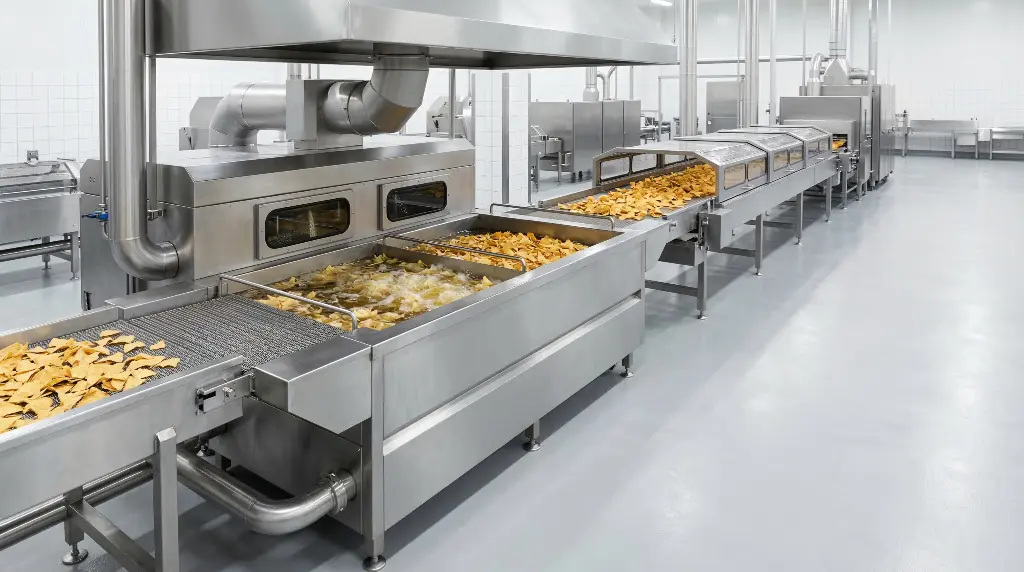
These limitations make it difficult to manage production in real time. For this reason, many food manufacturers are adopting real-time measurement technologies such as Near Infrared (NIR), which allow monitoring product properties on the production line.
What Is Near Infrared (NIR) Technology?
Near Infrared (NIR) technology is based on near infrared spectroscopy, an analytical technique that measures how materials absorb near-infrared light to determine their composition.
What does NIR do?
As products pass under the sensor, the system detects how near-infrared light interacts with the product at different wavelengths.
The product absorbs some wavelengths and reflects or transmits others.
These patterns allow the system to measure properties such as moisture, fat, or protein content.
What NIR Can Measure in Food Products
Because many food components absorb near-infrared light, NIR systems can measure several key properties that affect product quality and consistency.
These include:
- moisture content
- fat and oil levels
- protein levels
- colour or degree of bake.
.webp)
Where NIR Measurement Is Used in Food Production
Raw ingredient testing
Changes in ingredient composition can affect product consistency. Measuring key properties in raw materials allows manufacturers to verify quality before production begins.
Monitoring during mixing
Water content during mixing can affect recipe balance and product texture. By measuring moisture at this stage, manufacturers can adjust ingredient ratios in real time to keep the mixture within specification.
Controlling drying and baking processes
Monitoring moisture during drying or baking helps operators control drying time, oven temperatures, and energy use more accurately, helping to avoid under- or over-cooking.
Final product quality checks
NIR systems can also be used to verify that finished products meet required specifications.
This includes confirming moisture, colour, and fat levels, helping ensure that only products within specification move to the packaging stage.
Food Products Commonly Measured with NIR
- baked goods such as biscuits, crackers, and pastries
- snack foods such as crisps, cereals, popcorn, and nuts
- confectionery such as chocolate bars, cakes, and wafers
- grain products such as oats, corn, and flour
- coffee and cocoa.
How NIR Improves The Food Production Process
Real-time measurement during production
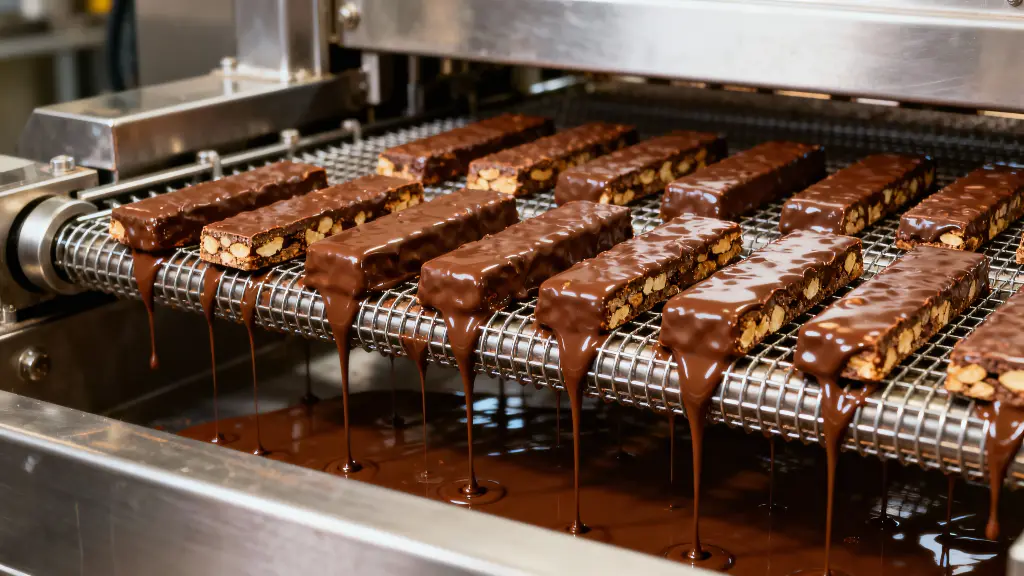
NIR sensors can be installed directly on production lines to measure products as they move along conveyor belts, without interrupting the production process.
Full-line product monitoring
Every product passes through the sensor and is monitored, giving food producers a clearer understanding of the production process.
Non-contact measurement
NIR sensors analyse products without touching them, so they remain intact, helping to reduce waste.
Immediate results for process control
Because NIR measurements are almost instantaneous, operators can quickly adjust ovens, dryers, roasters, or fryers to maintain product consistency.
Key Benefits of Using NIR Technology
- better control of production processes
- improved product consistency across batches
- reduced product waste
- faster quality control decisions
- lower energy use for drying and baking.
How EMCO Can Help You Improve Your Food Production Process
At EMCO, we help food manufacturers improve product quality and process efficiency using measurement technologies such as NIR analysis, packaging testing, and process monitoring.
Our team works closely with you to understand your production setup and identify the most effective measurement approach for your application.
We provide sample testing and assist with system implementation, so measurement solutions integrate smoothly into your production line. Our clients also benefit from ongoing support, including maintenance, troubleshooting, and calibration.
Get in touch to discuss your application.
Insights in this article are informed by EMCO’s process control specialist Kevin Goodison, who has extensive experience helping food manufacturers improve production processes through measurement technologies.